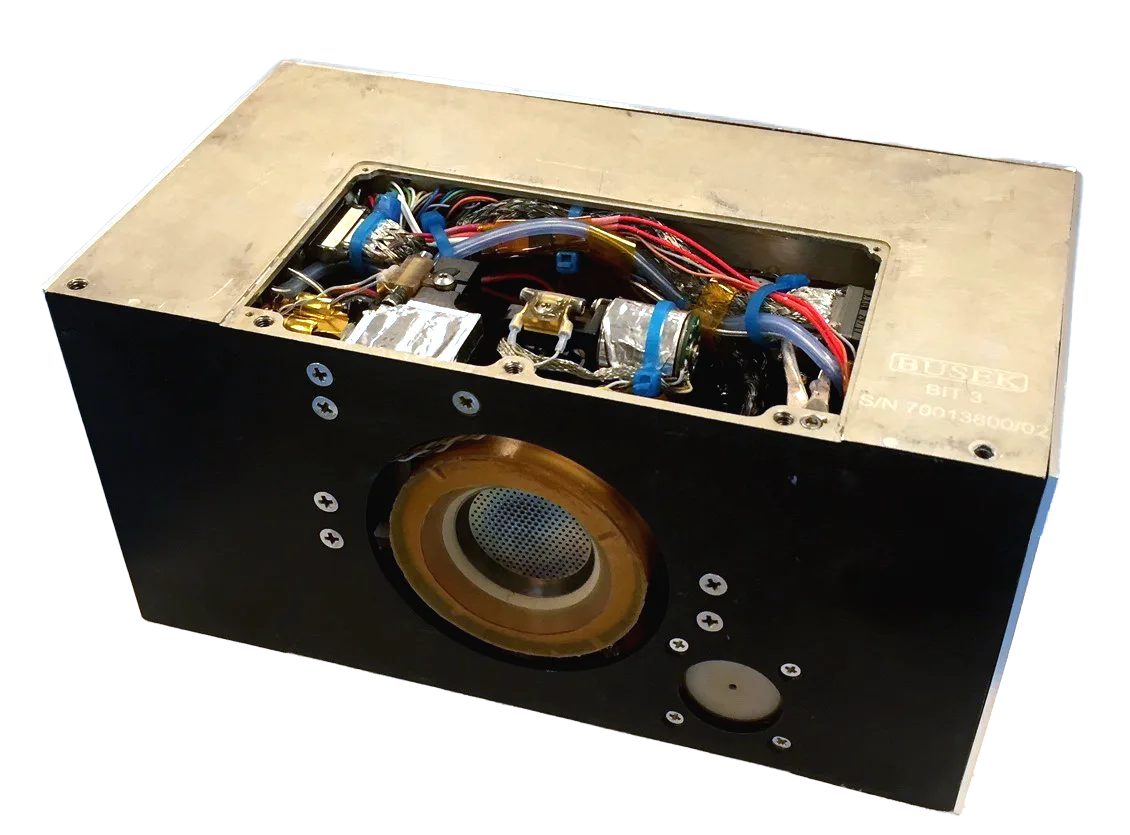
BIT-3 RF ion thruster
A small ion engine that runs on solid iodine and is sized for CubeSats, giving tiny spacecraft enough push to leave Earth orbit and travel on their own into deep space.
Why it matters
Small, cheap spacecraft usually ride along to wherever their rocket goes. A compact, efficient engine lets them change orbits or travel independently to the Moon or asteroids, which makes low-cost deep-space science possible.
How the technology works
Radio-frequency energy ionizes iodine propellant, and charged grids accelerate the ions out of the thruster. Busek lists up to 1.1 mN of thrust and a specific impulse of up to 2,150 seconds on 56 to 75 W of power.
Iodine can be stored as a solid, which avoids high-pressure xenon tanks; Busek verified performance with both propellants and said the thruster was slated for two deep-space CubeSats on NASA's SLS.
Sources
Updated Oct 22, 2026 · How we source facts · Suggest a correction